Countra
For ambulatory surgery centers

Two sets of hands. One record that has to close.

Countra replaces the paper binder for ambulatory surgery centers that handle controlled substances in-house. One record holds both halves of the count: what left your stock, and what was accounted for afterward, from delivery into inventory through witnessed waste.
One field to start. We carry it down to the full request so you do not retype it.

No dispensing cabinet, no staff pharmacist, no new hardware.
Set up in under an hour.
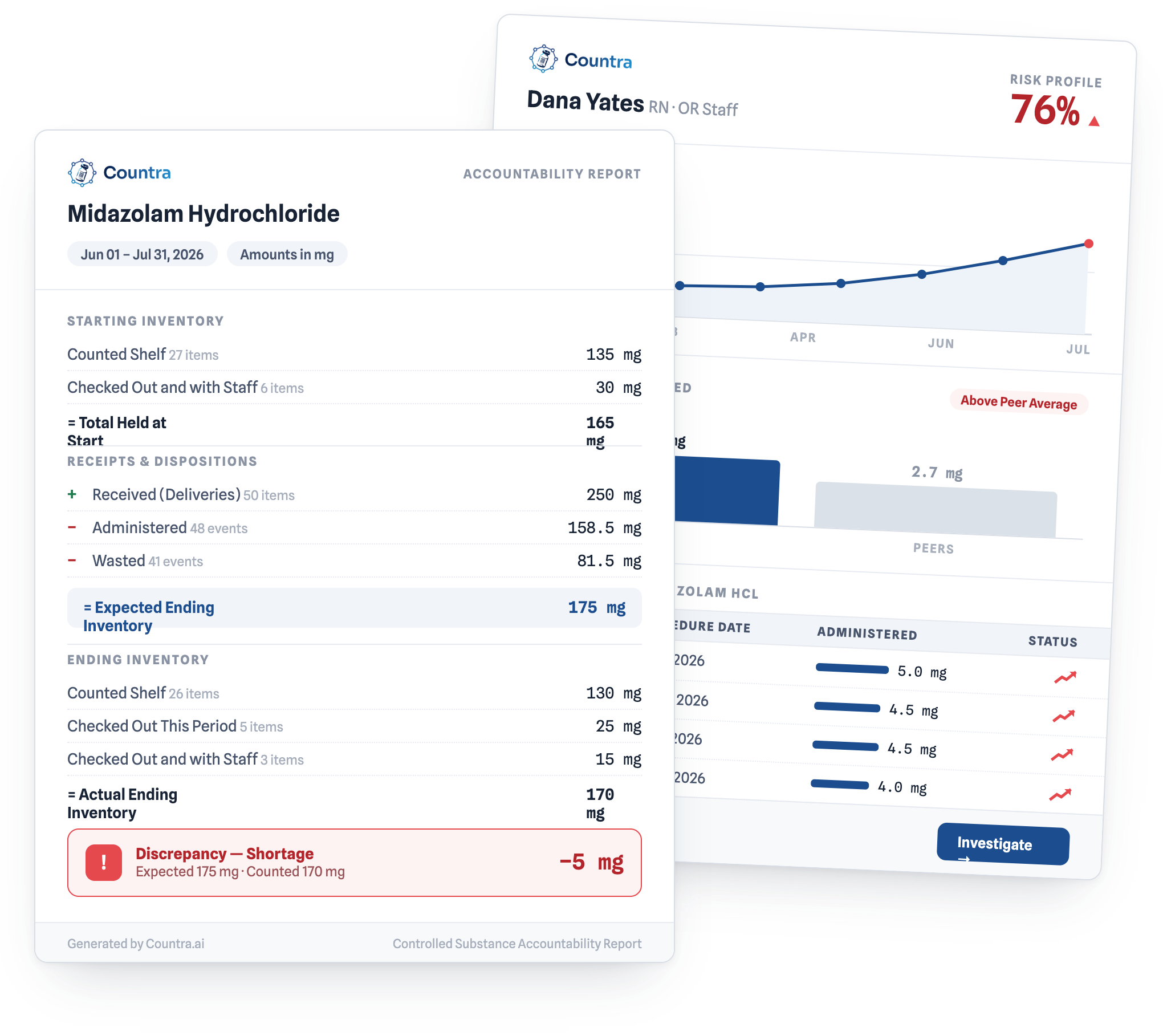
Illustration of two overlapping Countra screens. In front, a controlled substance accountability report for remifentanil hydrochloride, dated June 1 to July 31, 2026, showing starting inventory, receipts and dispositions, and ending inventory, and closing on a discrepancy row labeled shortage. Behind it, a staff detail view showing a risk profile figure, a monthly trend chart, a bar comparison against peers, and a table of amounts administered by procedure date. Illustrative interface, sample data.
What Countra is

Controlled-substance documentation and monitoring for ASCs, in one system.

Countra is controlled-substance documentation and monitoring software for ambulatory surgery centers that handle controlled substances in-house, without a hospital pharmacy behind them.

Countra replaces the paper binder. Your team logs delivery into inventory, checkout for a case, administration, and witnessed waste as it happens, and Countra keeps your perpetual inventory current and balances it against your physical count. Its AI-assisted monitoring compares usage, waste, and sequences of activity against peer patterns and is designed to surface an outlier as an alert for a person to review, a prompt to look closer rather than a conclusion. It works from the safe or cabinet already in your center, with the team already on your schedule.

Developed with NIH fundingCovered by Politico ProBuilt to support HIPAA safeguards
Tamper-evident records

A flag is a prompt to look closer, not an accusation and not a conclusion. Countra surfaces the pattern with the documentation behind it. The review, and the judgment, stay with you.

Where it actually starts

The half of the count that paper makes hardest to capture.

The count is arithmetic, and arithmetic needs two numbers. Most centers keep the two numbers in two different places.

The problem surfaces at the next count, not when it happens.

On paper, a discrepancy waits for count day to show itself. By then the case is closed, the room has turned over dozens of times, and the trail back to one entry is cold. When the surveyor asks how fast a loss gets detected, the binder's answer is measured in weeks.

A record of what was given is not a record of what left the safe.

A reconciliation needs two quantities: what left your stock, and what was accounted for afterward. The anesthesia record documents the dose, but it is organized by patient and it holds only one half. Your center's own record is the one that has to hold both, and today it usually holds them in two places: a binder for the stock side, and whatever gets written down between cases for the rest.

Your registration, your name.

Controlled-substance records trace back to a registrant, and the record that answers for yours is the one your center keeps.

You do not have a hospital pharmacy or a diversion officer. You have a locked cabinet, a count, and a room that turns over before the paperwork does.

The chain

One chain, two halves, one place they have to agree.

Every controlled substance in your center travels the same path. The top half is what your own record already holds. The bottom half is the half that has to be captured in the middle of patient care.

What your stock record holds
1
Delivery into inventory
2
Checkout for a case
What was accounted for
3
Administration
4
Witnessed waste with co-signature
5
Unopened container returned to stock
6
Reconciliation against perpetual inventory

The only place the two halves have to agree.

The question a surveyor is asked to answer

Your center's system, in the government's own words.

When a surveyor reviews your controlled substance records, the CMS State Operations Manual, Appendix L, tag Q-0181, directs them to ask a specific question.

Is the ASC's system capable of readily identifying loss or diversion of all controlled substances in such a manner as to minimize the time between the actual losses or diversion to the time of detection and determination of the extent of loss or diversion?

All drug records are in order and an account of all scheduled drugs is maintained and any discrepancies in count are reconciled promptly.

The guidance puts that reconciliation duty on the licensed healthcare professional your center designates as responsible for pharmaceutical services. It is a question about your system, answered by your own people.

Nobody else gets to answer it for you.

Countra records each step of handling along that chain and keeps the record ready to produce.

Recordkeeping first, then monitoring

Recordkeeping for every center. Monitoring on top of it.

Level 1: Recordkeeping

Digital controlled-substance records

Every center, from a single operating room up
  • Logs each step of handling, from delivery into inventory through witnessed waste
  • Reconciles against your perpetual inventory and supports the biennial count
  • Locks each entry once recorded, so the record stays tamper-evident
  • Exports inspection-ready PDF reports on demand
Level 2

AI-assisted monitoring

Monitoring works by comparison.
  • Compares usage, waste, and sequences of activity against peer patterns from providers performing the same kinds of actions
  • Queues an alert for your administrator with the records attached: informational for a deviation from peer patterns, actionable for a discrepancy waiting to be resolved
  • The peer-comparison analysis runs once a day, so an alert about a peer pattern arrives on a daily cycle
  • Needs at least two active providers anywhere in your organization, and the peer pool spans every location in the account

If your center is Quad A accredited, the standards already name what Countra is. Standard 6-D-2 accepts your controlled substance record in one of two forms: a sequentially numbered bound journal, or a tamper-proof, secure computer record. Countra is the second form.

Who this is built for

Ambulatory surgery centers that handle controlled substances in-house.

From a locked safe or cabinet, with no hospital pharmacy behind you. GI and endoscopy, ophthalmology, orthopedic, pain: if your own team stocks the controlled substances, counts them, and documents the waste, Countra is built for the way you already work.

If you have neither a hospital pharmacy nor a dispensing cabinet, most diversion-monitoring tools were not built for you. Countra was.

The record it keeps is your center's record whether your anesthesia providers are employed by the center or contracted. Your own OR nurses do the documentation in Countra, so the record does not depend on an outside group adopting new software.

The six steps

How a controlled substance moves through your center, and where Countra records it.

1

Delivery into inventory

Stock is received and logged into your perpetual inventory, with who logged it and when.

2

Checkout for a case

The controlled substance is signed out of stock for a specific case. A checkout for a case that is later cancelled, or for a drug that is never administered, stays on the record instead of disappearing between two pieces of paper.

3

Administration

The dose given to the patient is documented, with the name of the person who administered it and the date.

4

Witnessed waste with co-signature

Leftover drug is wasted and a second person co-signs. The co-signature is designed to be captured at the moment of waste, not reconstructed later.

5

Unopened container returned to stock

A container that was checked out and never opened goes back into stock, and the return is recorded on the same record as the checkout.

6

Reconciliation against perpetual inventory

Your perpetual inventory is balanced against your physical count, so a count that will not close is visible in the record, with the entries behind it.

Chain of custody

One record from delivery into inventory through witnessed waste, with who signed and when, ready to hand over without a fire drill.

Reconciliation

Your perpetual inventory balanced against your physical count, so a count that will not close is visible in the record, with the entries behind it. A reconciliation discrepancy is flagged for review immediately, as the entry is recorded.

Witnessed waste co-signature

The waste and the co-signature are recorded as one step, and the co-signature is designed to be captured at the moment of waste rather than reconstructed later.

Tamper-evident record

Entries lock once recorded. If a correction is needed, it is captured as a new time-stamped entry, so the original is never erased and the full history stays intact.

PDF export

Generate clean PDF reports of your records on demand: for an unannounced survey, for your accreditation file, or for whoever reviews your reconciliation. Your records are yours.

The record set

What your center has to be able to produce.

An ambulatory surgery center that holds a DEA registration has to be able to produce a defined set of controlled-substance records on request: an inventory, a continuing record of what came in and what went out, an administration record naming the person who gave the dose, executed order forms, and any theft or loss reports. Federal rules set the floor. Several states sit above it. This section lists the federal set with its citations, then what Countra records against it, and then what Countra does not do.

The federal record set

Inspection and copying
Records available for inspection and copying, for at least two years.
21 CFR 1304.04(a)
Executed order forms
Executed order forms are excluded from the central-records permission and stay at the registered location, and each inventory is maintained in written, typewritten or printed form at the registered location. Electronic copies of a Form 222 may be stored on a system elsewhere if they stay readily retrievable at the registered location.
21 CFR 1304.04(a)(1), 21 CFR 1305.17(c) and (e), and 21 CFR 1304.11(a)
In-house computer system
Records may be kept on an in-house computer system, with no notification to DEA and no central-recordkeeping approval required.
21 CFR 1304.04(c)
Inventory
An initial inventory on the date of first dispensing, and an inventory at least every two years after that, with a separate inventory for each registered location and an exact count or measure of the contents, not an estimate, for an opened container of a Schedule II substance.
21 CFR 1304.11
Received, delivered, disposed of
A complete and accurate record of every controlled substance received, delivered, or otherwise disposed of, maintained on a current basis.
21 CFR 1304.21(a)
Dispensed or administered
For each dose: the number of units, to whom, the date, and the written or typewritten name or initials of the individual who dispensed or administered it.
21 CFR 1304.22(c)
DEA Form 222
A DEA Form 222 or its electronic equivalent for each Schedule II order, kept separately from all other records for two years.
21 CFR 1305.03 and 21 CFR 1305.17(c)
Theft or significant loss
Written notice to your DEA Field Division within one business day of discovering a theft or significant loss, and a complete and accurate Form 106 within 45 days.
21 CFR 1301.76(b)
Securely locked cabinet
Effective controls and procedures to guard against theft and diversion, with Schedules II through V stored in a securely locked, substantially constructed cabinet.
21 CFR 1301.71(a) and 21 CFR 1301.75(b)

Two things the federal rules do not say

Federal law does not require a perpetual inventory. 21 CFR 1304.21(a) closes by saying that no registrant shall be required to maintain one. Perpetual inventory is a practice, and in several states a state requirement, but it is not a federal mandate.

Federal law does not require procedural waste to be witnessed. 21 CFR 1304.21(e) says the destruction of a controlled substance dispensed for immediate administration at your registered location, when it is not fully exhausted, is recorded under 21 CFR 1304.22(c) and need not be maintained on a DEA Form 41. The two-employee witness rule at 21 CFR 1317.95(d) attaches to on-site destruction of stock the center still holds, which is a different record. The witness requirement on procedural waste comes from state rules, accreditation standards and your own facility policy, and it varies.

What your state adds

Federal law is the floor, and many states sit above it, on their own clocks. Depending on the state, that can mean a perpetual inventory kept as a matter of law, reconciliation on a set schedule with a signed certification, a witness and co-signature required on procedural waste, or an inventory cadence faster than the federal two-year rule. The details differ from state to state, and a group operating in more than one state is running more than one set of rules at once. Confirm your own state's requirements with counsel and your state board of pharmacy.

What Countra records against that list

Delivery into inventory, with who logged it and when
Checkout for a case, tied to the case
Return to stock for an unused item, recorded as its own entry, so the checkout closes
Administration, with the person who administered it and the date
Witnessed waste, with the co-signature designed to be captured at the moment of waste
Reconciliation against your perpetual inventory, with support for the biennial inventory
Entries locked once recorded, with corrections captured as new time-stamped entries, so the record stays tamper-evident
Inspection-ready PDF reports on demand, for a date range you choose

What Countra does not do

Does not make a facility DEA compliant
Does not file DEA forms, including Form 222, Form 41 and Form 106
Does not prevent or guarantee the detection of diversion
Does not replace your judgment or conclude a case for you
Is not a prescription drug monitoring program
Does not require, and does not replace, a dispensing cabinet or a staff pharmacist
Does not do the physical handling or the co-signing. Your staff still do that.
Countra records the workflow; it does not perform it.

This page describes federal and state requirements in general terms. It is general information, not legal advice. Countra and Autonomous Healthcare, Inc. are not affiliated with, endorsed by, or acting on behalf of the Drug Enforcement Administration, the Centers for Medicare and Medicaid Services, any state board of pharmacy, or any accrediting organization. Confirm every requirement with your own counsel and your state board of pharmacy before you rely on it.

Reviewed and current as of August 28, 2026.

Print this section
Binder against Countra

A binder holds one half. A reconciliation needs both.

Capability
Paper binder
Countra
Digital controlled-substance record
Checkout for a case tied to the record
On separate paper, when time allows
Witnessed waste co-signature captured at the moment of waste
Captured when the room allows
Designed to be captured at the moment of waste
Reconciliation against perpetual inventory
Manual, on its own schedule
Records ready to produce without assembling a binder
No dispensing cabinet or staff pharmacist required
What actually backs it up

Built for the buyer who reads the fine print.

Controlled-substance records are legally serious. Here is what stands behind Countra.

NIH

Countra's approach to controlled-substance monitoring came out of work supported by the National Institutes of Health and the National Institute on Drug Abuse.

In use today
Countra is in use in clinics today, and it is set up in under an hour, on the devices your team already has.
Press Coverage
Politico Pro covered the federal funding behind AI for drug diversion, and quoted Countra's co-founder and CEO. Read the article, June 2024, PDF.
Questions surgery centers ask

Controlled substances, surveys, and who is responsible.

What software do ambulatory surgery centers use to track controlled substances?

Most ambulatory surgery centers track their own procedural stock in a paper binder. Countra is a digital option built for surgery centers that handle controlled substances in-house, with no hospital pharmacy, no dispensing cabinet and no staff pharmacist: it replaces the binder, keeps a reconciled record from delivery into inventory through witnessed waste, and exports that record as a PDF on demand. And because the record is data rather than ink, Countra can also read it: built-in analytics flag unusual patterns early, so a quiet question gets asked in days, not at the next count. It covers the drugs a center actually stocks for sedation and anesthesia, such as fentanyl (Schedule II), ketamine (Schedule III) and midazolam (Schedule IV). It does not require a dispensing cabinet or a staff pharmacist, and it runs on the smartphone, tablet, desktop or laptop your team already uses.

What controlled-substance records will an inspector or a surveyor ask a surgery center to produce?

The federal set: your inventories, a continuing record of every controlled substance received, delivered or otherwise disposed of, an administration record naming the person who gave each dose, executed order forms kept separately, and any theft or loss reports. Federal rules require those records to be available for inspection and copying for at least two years (21 CFR 1304.04(a)), and they expressly allow them to be kept on an in-house computer system, with no notification to DEA required (21 CFR 1304.04(c)). A CMS surveyor works from a different document: the State Operations Manual, Appendix L, tag Q-0181, under 42 CFR 416.48(a), which asks whether the center's record system tracks scheduled drugs in a readily retrievable manner and whether discrepancies in count are reconciled promptly. Countra keeps the records it holds in one place, from delivery into inventory through witnessed waste and the reconciliation, and exports them as a PDF on demand. It does not hold or file your order forms or your theft and loss reports. Filing forms and maintaining compliance remain the registrant's responsibility, and state requirements vary, so confirm yours with counsel and your state board of pharmacy.

How do surgery centers document witnessed waste, and what do the rules actually require?

Federal rules require the wastage to be recorded, but they do not impose the two-person witness. 21 CFR 1304.21(e) says the destruction of a controlled substance dispensed for immediate administration at your registered location, when it is not fully exhausted, is recorded under 21 CFR 1304.22(c) and need not be maintained on a DEA Form 41. The two-employee witness rule at 21 CFR 1317.95(d) attaches to on-site destruction of stock the center still holds, which is a different record. The witness requirement on procedural waste comes from state rules, accreditation standards and your own facility policy, and it varies from state to state. In Countra, the waste and the witnessed co-signature are captured as a single record, with a time stamp the entry carries for good. Confirm every requirement with your own counsel and your state board of pharmacy before you rely on it.

Does Countra make my surgery center DEA compliant?

No. Compliance with the Controlled Substances Act and DEA recordkeeping rules is the registrant's own responsibility, and no software can take it over. Countra supports those obligations by helping you document, track, and reconcile controlled substances and keep audit-ready records. Its analytics also flag unusual patterns for your review, which can shorten the time between a discrepancy and someone noticing it. But Countra does not make a facility DEA compliant, does not file your DEA forms, and does not prevent or guarantee the detection of diversion. Monitoring surfaces questions; answering them remains your program's job.

Do we need a dispensing cabinet or a staff pharmacist to use Countra?

No. Countra is built for the way surgery centers without a hospital pharmacy actually handle controlled substances: from a locked safe or cabinet, without an automated dispensing cabinet, and without an on-site pharmacist. Federal survey guidance says the same thing. CMS State Operations Manual Appendix L, tag Q-0180, says a pharmacist is ideally available to an ASC but that this is not required by the regulation, unless the center performs activities that under state law may only be performed by a licensed pharmacist. What 42 CFR 416.48 requires is that drugs and biologicals be provided under the direction of an individual designated responsible for pharmaceutical services. Pharmacist presence and its cadence come from state rules and accreditation standards, and they vary. Your existing clinical staff document each step as part of the routine they already run.

Will our anesthesia providers have to document everything twice?

No new record is being created. The anesthesia record stays in the patient's chart, exactly where it is. Countra holds the other record, the center's own controlled-substance record that a binder holds today, and the entries it asks for are the ones that record already requires: the checkout, the administration entry, the witnessed waste, the count. Each is a short digital entry on a device the person already has, instead of a line written onto paper between cases. And for centers that run an EHR, Countra connects to modern EHR systems, so an administration documented in the chart carries into the controlled-substance record without being typed twice. Whoever documents a step in your workflow today documents that same step in Countra, once.

Who is responsible for controlled substances in an ambulatory surgery center when the anesthesia group is contracted?

The center's governing body carries it. Under 42 CFR 416.41, the center must have a governing body that assumes full legal responsibility for determining, implementing and monitoring the policies governing the center's total operation. Where a service is provided through a contract with an outside resource, 42 CFR 416.41(a) requires the center to assure that the service is provided in a safe and effective manner. Contracting the anesthesia service does not move that duty. In practice the work is shared, and the split varies: the ordering, stocking and counting often sit with the center's own staff, and in Countra the dose is documented by the center's own rotating OR nurses. Controlled-substance records trace back to a registrant, so it is your registration and your name on the line, whoever is holding the vial.

Can we get our controlled-substance records out of Countra?

Yes. Your records are yours. You can export them as PDF reports at any time, for an inspection, a survey, or your own files, and you can take your complete controlled-substance history with you if you ever leave the platform.

Does Countra work if our anesthesia providers are contracted?

Yes, and your anesthesia providers do not need access to Countra. The controlled-substance documentation in Countra is done by your center's own rotating OR nurses, not by your anesthesia providers. Anesthesia providers keep logging their information in the anesthesia record the way they do now, and Countra does not change that flow or the way anesthesia records are kept. Countra is only for controlled-substance documentation. If your center has an EHR, Countra can pull information from it to avoid documenting the same thing twice. Whether your anesthesia group is employed or contracted, the people entering the record are your own staff.

See it on a day in your own center

See how it fits the way your center already runs.

A short demo walks through delivery into inventory, checkout for a case, administration, witnessed waste, and the reconciliation, on the workflow your team already runs.

Prefer to talk? (650) 447-1122
Developed with NIH funding
Built to support HIPAA safeguards
Tamper-evident records
  • Simple enough for non-technical staff
  • Your records are yours, exportable at any time
  • No dispensing cabinet or staff pharmacist required

Request a Demo

See Countra run on a center like yours. About 20 to 30 minutes, screen share, real workflow.

We saved your email. Add a few details and we will find a time.

We'll email you to find a time. We will not share your information or add you to a mailing list.

Inspection-ready recordsFor ambulatory surgery centers
Request a Demo